UNC Informative Talk: Sustainable Technologies
Wastewater Treatment

UNC Informative Talk:
Sustainable Technologies
Wastewater Treatment

On March 16, 2023, an informative talk was given at the National University of Córdoba, Argentina. The talk was given by Germán Raffo, one of our engineers, who, together with his twin brother Dino Raffo, has completed his engineering studies at the University.

In this article we can find the content that was discussed in this event, where the problem of wastewater is discussed, and its possible solutions through sustainable technologies, both on a domestic scale for a single-family house, as well as for multifamily, industrial and urban scale.

Following are Germán’s words

Hello good afternoon, my name is Germán Raffo, I am part of a family of engineers with self-sufficient and sustainable horizons. It is mainly my uncle, Fernando Raffo, who has more than 15 years in the field of wastewater treatment.

Together with my twin brother, Dino Raffo, we studied Civil Engineering here at the National University of Cordoba, and also a master’s degree at the Politecnico di Torino, Italy, where Dino specified in Architecture, and in my case in Hydraulics.

After this, after three years of development and work, we formed a project with the purpose of reducing the environmental impact produced by human wastewater. The project is called The Wave, where we are dedicated to raise awareness about the problem, and to advise and design wastewater treatment systems for any particular problem. Both single-family, multi-family, subdivisions, urban and industrial scales.

THE WAVE – A Family of Engineers with self-sustainable horizons

Introduction to the problem

Nowadays, here in Córdoba, only 4% of the wastewater is properly treated, according to what is established in the Decree 847/16 of the State of Córdoba (“Reglamentación de Estándares y Normas sobre Vertidos para la Preservación del Recurso Hídrico de la Provincia de Córdoba”).

In cities such as Carlos Paz, we can observe a great tourist and real estate development, which is generating a great increase in the amount of water used, and, therefore, a great increase in the amount of wastewater produced.

It is very important, for this reason, to be aware of the conditions in which we return these waters, and the impact that this problem is having on the environment, demanding as citizens that something must be done about it to avoid an almost irreversible deterioration of water resources, as we can notice in municipalities that have faced this type of growth.

San Roque Lake Water Intake – March 2022

I would like to talk mainly about the possible solutions and not so much about the problem, what can we do, from our position, regarding this problem.

Starting with different solutions that we can find to treat our own wastewater, thus being part of the solution and not part of the problem.

What types of systems can we implement on a domestic scale?

Depending on what water purification status we want to achieve, and where the wastewater is directed to, we can opt for different solutions.

First it is necessary to understand and differentiate between a primary system, a secondary system and a tertiary treatment system.

A primary system is a system in which anaerobic effluent treatment takes place. That is to say, a system that acts in the absence of oxygen, where anaerobic bacteria proliferate, which are in charge of diluting and diminishing the organic load contained in the water.

This type of system is usually a tank with a volume proportional to the flow to be treated, where the water is pre-treated.

They are essential prior to a secondary or tertiary system, since in these types of primary systems, the fast sedimentation solids are retained, and the organic load in the water is diluted, homogenizing the load and eliminating the solids that can clog the secondary or tertiary treatment system.

As an example of these systems, we can find Septic Tanks, commercial Biodigesters, etc.

Example of primary system : Septic Tanks & Biodigester

A secondary system, however, is a system in which aerobic treatment takes place. That is, a system that acts in the presence of oxygen, where mainly aerobic and photosynthetic bacteria act, which, together with a plant species, close the pollutant cycle by transforming them into nutrients for the plants.

An example of these systems are artificial wetlands, or large-scale forests.

We will go deeper into the functioning of these systems later on.

Example of a secondary system : Constructed Wetlands

A tertiary system is a system of infiltration of water into the ground. In this type of system, water is absorbed through an absorption surface between the system and the ground, where the water infiltrates into the ground.

An example of a tertiary system is an absorption well or infiltration trenches.

In these systems, an aerobic treatment takes place in the pores of the soil, where aerobic bacteria act and fungi proliferate, which finish treating the pollutants before they reach the groundwater aquifer.

Example of a tertiary system : Absorption Well and Infiltration Trenches

What do the standards recommend?

The standards that regulate the pollutant status of wastewater differentiate between two different requirements in terms of the pollutant parameters contained in wastewater when it is returned.

One requirement is for water returned through a tertiary system of infiltration into the ground, and another requirement is for water discharged directly into rainwater drains, rivers or the lake.

Recommended discharge parameters : Differentiating whether the water is directed to an infiltration system, or if it is directed to a pluvial drainage system, rivers, lakes…

So, which system is recommended to solve the problem?

It depends on where our wastewater goes, but whatever the case, a primary treatment system is essential.

If a tertiary system is in place, only a well-designed primary system may be sufficient to achieve the water pollutant parameters required to comply with Table 1.

In cases where the treated water is to be reused for direct irrigation or returned to a surface watercourse, a secondary system is required in addition to a primary system to achieve the values established in Table 2.

Which system should I choose?

In order to implement a primary treatment system, one can opt for treatment using a well-designed septic tank system or commercial biodigesters.

The main differences between these two systems are maintenance and cost. On the maintenance side, both systems, when performing anaerobic decomposition, produce a sedimentation of sludge at the bottom, which must be removed after a certain period of time. In the case of the biodigester, they are usually removed twice a year, and in the case of septic tanks, this time is usually between 3 and 5 years, depending on the volume and height of the tank. From the point of view of cost, from our experience, we always ended up being more economical to opt for septic tanks.

For a secondary treatment system, you can opt for an constructed wetland, or any other aerobic treatment technology.

As for the tertiary system, infiltration trenches can be chosen, if space permits, because of their lower cost. Otherwise, absorption wells can be used.

In both cases, for proper sizing, a soil infiltration study is necessary, which you can do yourself with a simple technical manual.

What is a constructed wetland?

An artificial wetland, also called a biofilter, is a secondary treatment system for sanitary effluents.

This system is mainly composed of a granular media and plants. The granular medium serves as a base for the surface life of plants, and also the contaminated water flows through it so that the pollutants are filtered through this medium, deposited around the roots of the plants, which, through phytoremediation, end up being transformed into nutrients for the plants.

So the pollutants end up transformed into plants, while the water passes clean to a system for irrigation reuse, an infiltration system, or a surface course.

What these types of systems do is to replicate what happens spontaneously in nature on wetlands, therefore their name.

Scheme of wastewater treatment system with primary and secondary system

Why is it the best solution?

  • They have clear economic advantages, due to their low construction and maintenance costs and reduced or zero energy consumption.
  • They have excellent purification performances, especially for parameters such as BOD, COD, suspended solids, bacterial load and nitrogen.
  • They are easy to operate.
    Optimal oxygenation of treated water.
  • Optimal landscape integration.
  • Environmental reclamation of degraded sites.
  • Opportunity to reuse treated water and biomass, developing the logic of recycling, closing the cycle of some nutrients, such as Nitrogen and Phosphorus.
  • Possible construction by growth stages.
  • Optimal solution for variable hydraulic loads.


Different types of Constructed Wetlands

This can be of different types in terms of its style of operation.

It can be a subsurface horizontal flow wetland, where the water flows under a certain height of granular soil, and where the water flows horizontally, entering from one end of the system, and exiting at the other end.

Another type of these systems is a subsurface vertical flow wetland, which like the previous one, the water flows under the granular soil, but in this one the water flows vertically, entering from the top and exiting from the bottom.

There are also free-flow wetlands, where the water is in contact with the surface, which are usually used as a tertiary system after a subsurface wetland.

Architectural Solution Ideas

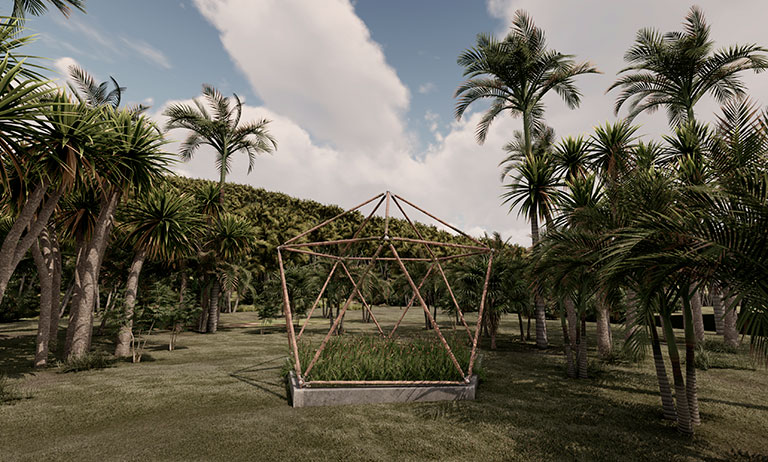
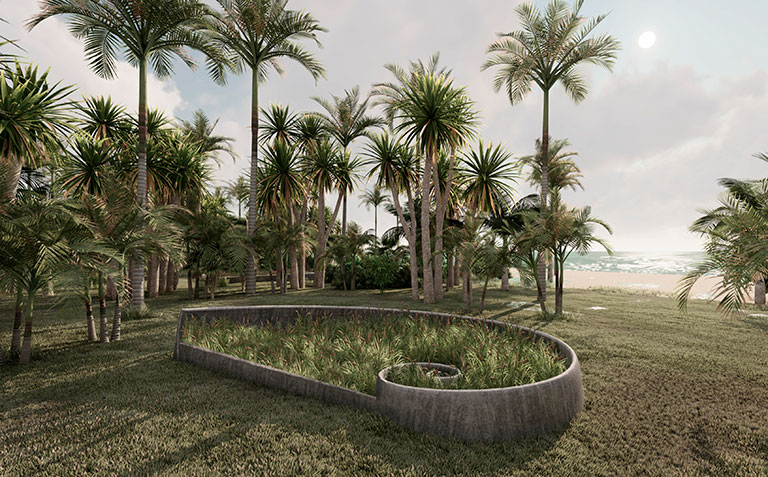
The biofilter design can be adapted to have a more aesthetically pleasing architectural design.

Analogous large-scale solutions

In situations of a high quantity of wastewater with a high organic load contained in it, mega systems of this type have to be made to solve the problem.

In the following images we can see the treatment system of a meat processing plant that slaughters 80,000 chickens per day, using about 2,000,000 liters of clean water per day, and returning that amount in wastewater with a BOD of 1500 to 2000 milligrams per liter.

For this case, a primary system using facultative lagoons and a secondary/tertiary system using afforestation forests.

Fadel poultry processing plant, which uses about 2,000,000 liters of water per day.

Wastewater treatment of poultry slaughterhouse in Entre Rios, Argentina. Conducted by a facultative lagoon system, with discharge to forest irrigation, obtaining a zero wastewater discharge impact and acting as carbon sinks.

Wastewater Treatment of an Incubator Plant. Carried out independently through an artificial wetland for the water used by personnel, and through a system of facultative lagoons for the industrial water, usable for agricultural irrigation.

Also, we can find scales of urbanizations, also treated using facultative lagoons and forests, such as the following examples of communities of 6,000 and 80,000 inhabitants.

Example of treatment plants using facultative lagoons and forests in two locations in Argentina.

Lagoon System in Mendoza – 1.8 million inhabitants

This was the end of the engineer’s words, with the respective images he used in his presentation.

Engineers Dino and Germán Raffo from The Wave together with Engineer Santiago Merino from FCEFyN Extension Department.

We would like to thank the National University of Córdoba and the Extension Departtment for making this possible. Also to you for coming here, raising awareness of the problem that involves us all from our main element, Water.

Follow us on Instagram to find out about every release of information regarding this issue by clicking here.

Domestic wastewater teatment

The UNC Civil Engineer, Dino Raffo, presents his Thesis of Laurea Magistrale in Ingegneria Edile with courses at the School of Architecture, Castello del Valentino, at the Politecnico di Torino, in Italy.

Dino shares in his final thesis a complete analysis of the solutions for domestic wastewater treatment.
Shared here in Italian, English and Spanish.

Leer Más »